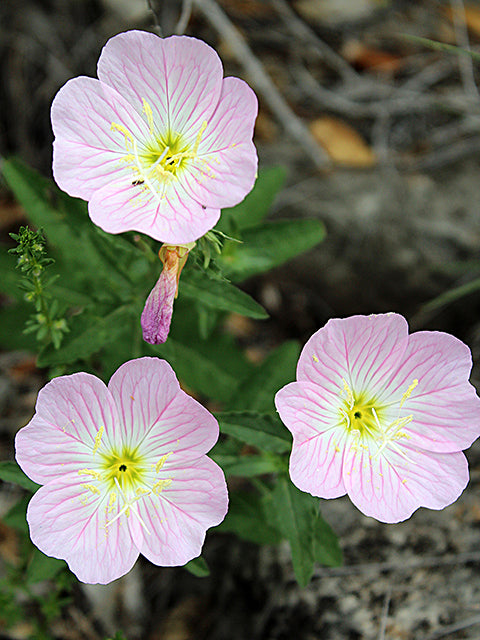
Showy Evening Primrose (Oenothera speciosa)
Showy Evening Primrose (Oenothera speciosa)
20 in stock
Couldn't load pickup availability
Oenothera speciosa Nutt.
Pink Evening Primrose, Showy Evening Primrose, Mexican Evening Primrose, Showy Primrose, Pink Ladies, Buttercups, Pink Buttercups
Onagraceae (Evening Primrose Family)
Synonym(s): Hartmannia speciosa, Oenothera delessertiana, Oenothera speciosa var. childsii
USDA Symbol: oesp2
Originally native only to central grasslands from Missouri and Nebraska south through Kansas, Oklahoma, and Texas to northeastern Mexico, Pink Ladies or Pink Evening Primrose is an upright to sprawling, 1-2 ft. perennial, which spreads to form extensive colonies. Its large, four-petaled flowers, solitary from leaf axils, range in color from dark pink to white. Nodding buds, opening into pink or white flowers, are in the upper leaf axils on slender, downy stems. The delicate-textured, cup-shaped blossoms are lined with pink or red veins. Foliage is usually linear and pinnate, although leaves can be entire and lance-shaped depending on locality. A hardy and drought resistant species that can form colonies of considerable size. The flowers may be as small as 1" (2.5 cm) wide under drought conditions. The plant is frequently grown in gardens and escapes from cultivation.
As the common name implies, most evening primrose species open their flowers in the evening, closing them again early each morning. The flowers of some members of the genus open in the evening so rapidly that the movement can almost be observed. Pink evening primrose populations in the southern part of its natural range, however, open their flowers in the morning and close them each evening. To further complicate matters, populations in the northern parts of its range tend to open in the evening.
Plant Characteristics
Habit: Herb
Leaf Retention: Semi-evergreen
Fruit Type: Capsule , Caryopsis
Size Notes: Up to about 2 feet tall.
Leaf: Medium green. Some leaves red in autumn.
Flower: Flowers 2 inches across
Bloom Time: Feb , Mar , Apr , May , Jun , Jul
Bloom Notes: In southern parts of its range, blooms tend to be darker pink or rose and to open in the morning. Northern populations are often paler or white and night-blooming. An average coloration would have shell-pink blooms that transition to white in the center and are veined in a deeper pink. Flowers release a scent starting at dusk. In the most southerly parts of its range, from Chihuahuan Desert grasslands to northeastern Mexico, blooms whenever temperatures are above freezing. Elsewhere, blooms heaviest during spring, with blooms diminishing in size as the weather gets hotter. Each flower lasts only a single day.
Distribution
USA: AL , AR , AZ , CA , CT , FL , GA , IA , IL , IN , KS , KY , LA , MO , MS , NC , NE , NM , OH , OK , PA , SC , TN , TX , UT , VA , WVNative Distribution: Originally native only to grasslands of Nebraska, Kansas, Missouri, Oklahoma, Texas, and northeastern Mexico. Naturalized elsewhere.
Native Habitat: Prairies, Plains, Meadows, Pastures, Savannas, Hillsides, Slopes, Woodland edges, Forest openings.
Growing Conditions
Water Use: Low , MediumLight Requirement: Sun
Soil Moisture: Dry , Moist
Soil Description: Readily colonizes in open areas in a variety of well-drained soils, rich or poor, dry or moist, disturbed or not: loams, clays, sand, caliche, rocky, or gravelly.
Conditions Comments: It cannot withstand complete soil dryness. Plants often go dormant in summer, resprouting with fall rains. Can work as a dense foliage groundcover in shade, but won't bloom without adequate sunlight.
Benefit
Use Ornamental: Full sun groundcover with showy flowersUse Wildlife: Seed capsules attract birds, especially finches, and various mammals.
Use Food: Cook as greens or in salads, best flavor when collected before flowering.
Conspicuous Flowers: yes
Attracts: Birds
Nectar Source: yes
Deer Resistant: High
Value to Beneficial Insects
Special Value to Native BeesImage Information
Photographer: Schroeder, SusanCity: Camp Wood
County: Real
State: TX
Location Notes: Roaring Springs Ranch
Accession date: 2025-09-08
Filename: SMS_IMG1015.JPG
Slide Index: SMS_OESP2-20120414-02.jpg
Restrictions: Unrestricted
Collection: Wildflower Center Digital Library
Original Format: Digital
Orientation: Portrait
Shot: Close-up of flowers.
Date Taken: 2012-04-14
NPIN Image Id: 185074