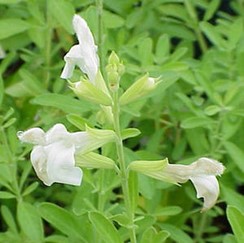
Autumn Sage - White (Salvia greggii)
12 in stock
Couldn't load pickup availability
Salvia greggii
Salvia greggii A. Gray
Autumn Sage, Gregg Salvia
Lamiaceae (Mint Family)
Synonym(s):
USDA Symbol: sagr4
Autumn Sage is a soft, mounding shrub normally 2-3 ft. tall, with small, mintily aromatic green leaves that are evergreen in warmer climates. The flowers are borne on racemes from spring to frost and can be red, pink, purple, orange, or white. Its natural range is from south-central and west Texas south to San Luis Potosi in Mexico, mostly on rocky slopes.
A popular landscape plant in the Southwest, Autumn sage is delightful to use as a small, ornamental, flowering shrub in a perennial bed or as a low hedge. Its aromatic foliage quickens the senses and its flowers are sure to draw hummingbirds. The color of its blossoms in the wild is usually red but varies from area to area, with some regions dominated by red-blooming plants, others pink, others orange, others purple, and others white, plus many shades in between. The color range has been further enhanced by breeding, resulting in many cultivars over the years. It is disease and insect free and drought tolerant, and once established, should not be fertilized.
Plant Characteristics
Habit: Shrub
Leaf Retention: Evergreen , Semi-evergreen
Leaf Arrangement: Opposite
Leaf Complexity: Simple
Leaf Shape: Elliptic , Obovate
Leaf Pubescence: Glabrous
Leaf Margin: Entire , Serrulate
Leaf Apex: Obtuse
Leaf Texture: Smooth
Breeding System: Flowers Unisexual , Monoecious
Inflorescence: Raceme
Size Notes: Normally 2-3 ft but can reach 5 ft
Leaf: Leaf margins may be entire, serrulate or minutely serrulate.
Flower: Flowers 1 inch long
Fruit: Nutlets.
Bloom Time: Mar , Apr , May , Jun , Jul , Aug , Sep , Oct , Nov
Bloom Notes: Depending on provenance, will bloom most heavily either in spring or in fall, with scattered blooming in summer and until frost. Flower color differs according to provenance and breeding, ranging from red to orange to pink to purple to white, with many shades in between.
Distribution
USA: TXNative Distribution: Central and west Texas south to San Luis Potosi in Mexico
Native Habitat: Well-drained, rocky slopes. Usually in rocky soils in central, south, and west Texas.
Growing Conditions
Water Use: LowLight Requirement: Sun
Soil Moisture: Dry
Drought Tolerance: High
Cold Tolerant: yes
Heat Tolerant: yes
Soil Description: Well-drained, rocky soils, usually limestone of greater or lesser organic content. Also in sands and loams.
Conditions Comments: Autumn sage must have a well-drained site and cannot take shrink-swell clay soils. In clay soils, work in organic matter and amendments to improve drainage and, if possible, plant on a slope. Though generally cold tolerant, will be deciduous in regions with extremely cold winters, though some cultivars do well even in Oklahoma and Colorado, well outside of its natural range. Avoid planting it near heavy foot traffic because the stems are very brittle.
Benefit
Use Ornamental: Valued for its nearly evergreen habit, its colorful, long-lasting, hummingbird-attracting blooms, and the denseness of its growth, which makes it useful as a low hedge.Use Wildlife: Flowers attract bees and hummingbirds.
Use Food: As with many Salvia species, leaves can be used fresh or dried for seasonings and teas, and the flowers are edible.
Conspicuous Flowers: yes
Fragrant Flowers: yes
Fragrant Foliage: yes
Attracts: Butterflies , Hummingbirds
Nectar Source: yes
Deer Resistant: High
https://www.wildflower.org/plants/result.php?id_plant=sagr4